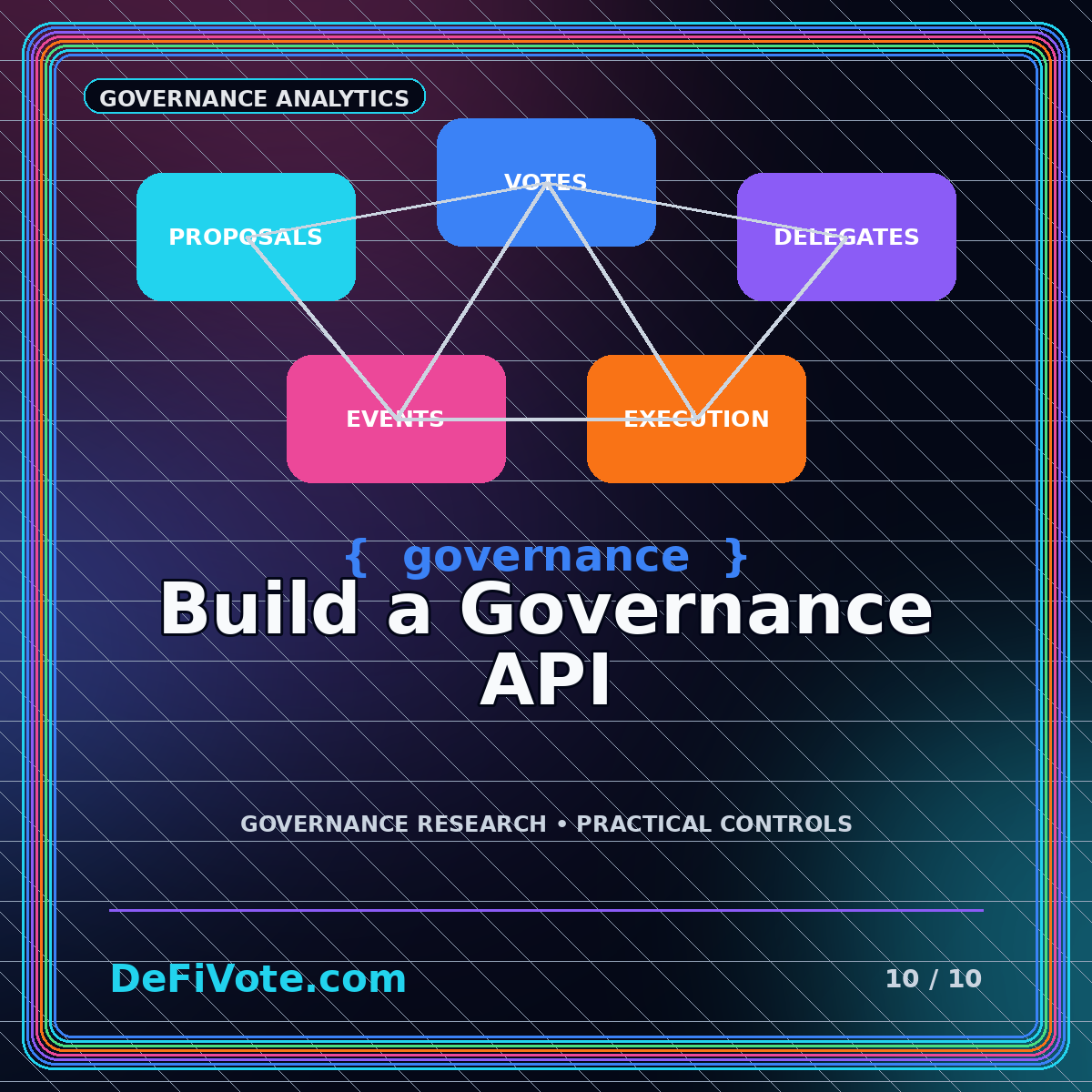
A governance API turns contract events, proposal metadata, signed ballots, delegation records, and execution transactions into data that applications can query reliably. The difficult part is not exposing a list of proposals. It is preserving provenance across different governance frameworks, handling chain reorganizations, representing historical voting power, and distinguishing what a proposal says from what its executable actions actually do. A good data model supports interfaces, alerts, analytics, archives, and independent verification without hiding the underlying records.
Define the API’s consumers and guarantees
Start with the products that will use the data. A voting interface needs current proposal state, eligibility, choices, and transaction construction. A notification service needs state transitions and user subscriptions. An analytics dashboard needs historical votes, delegation changes, and normalized outcomes. An archive needs durable metadata and content hashes. These consumers may share entities while requiring different latency and consistency guarantees.
Document what the API guarantees. Is data finalized only after a number of blocks? Are off-chain votes included? Does “executed” mean the governor emitted an event or that downstream state was verified? Can proposal descriptions be edited? Clear semantics prevent applications from treating an indexed convenience field as stronger evidence than the source supports.
A canonical organization model
The organization entity should represent a governance system, not merely a token contract. Useful fields include chain identifiers, governor addresses, voting-token addresses, timelocks, execution modules, proposal source, forum and metadata locations, and framework type. Version these relationships because a DAO may migrate governors while preserving historical identity.
A single organization can have several governance tracks: executable token votes, off-chain polls, security-council elections, grants committees, or cross-chain instances. Model tracks explicitly so clients do not combine incompatible states or assume every proposal has the same approval and execution rules.
Proposal data should separate text from actions
A proposal record needs an immutable identifier, organization, proposer, creation event, snapshot, start and end, choices, state, quorum rule, approval rule, and metadata references. Preserve the raw description and content hash. Parsed fields such as title and summary are useful, but clients should be able to retrieve the original material.
Executable actions belong in a related collection. Each action can contain target, value, function signature, raw call data, decoded arguments, chain, position in the batch, and simulation results. Separating actions makes it possible to compare the narrative with the code and to represent proposals that have no executable payload.
Votes require historical context
A vote record should include voter address, support choice, weight, reason or rationale, transaction or signature reference, timestamp, block, and source. Store both the raw weight emitted or calculated by the framework and the normalized display value. Token decimals, vote-escrow formulas, and strategy combinations can otherwise produce inconsistent totals.
Voting power is historical. An API should not calculate an old vote from a user’s current balance. Use checkpoint methods, snapshot blocks, strategy inputs, or indexed delegation state appropriate to the framework. Preserve enough provenance to reproduce the value: contract addresses, strategy identifiers, block number, and any off-chain calculation parameters.
Delegation is a time-series graph
A current delegate field is convenient but insufficient. Governance applications need delegation events with delegator, delegate, amount or token context, effective block, transaction, and previous state. This creates a graph that can be reconstructed at any proposal snapshot. It also supports concentration analysis and alerts for large movements.
Some systems support split delegation, token-specific delegates, or separate representatives for proposal creation and voting. Avoid forcing every model into one delegator-to-one-delegate relationship. Use framework adapters that map native events into a canonical structure while retaining raw fields for advanced clients.
Ingest events with reorganization safety
Blockchains can reorganize, replacing recently observed blocks. An indexer should store block hashes, process events idempotently, and mark data as unfinalized until the configured confirmation depth. When a reorganization occurs, roll back affected derived records and replay from a known ancestor. Clients that need low latency can consume provisional updates if the API labels them clearly.
Use deterministic event identifiers based on chain, transaction hash, and log index. Maintain an ingestion cursor per chain and contract. Backfills should produce the same state as live processing. These practices matter because governance alerts and proposal states are especially sensitive to duplicate or missing events.
Normalize without erasing framework differences
Governor contracts, Snapshot spaces, staking modules, multisigs, and custom frameworks use different state machines. A canonical API can expose common concepts such as pending, active, succeeded, defeated, queued, executed, canceled, and expired, but it should also retain the native state and rule set. Clients may need to know whether “succeeded” includes a veto threshold or whether quorum excludes abstentions.
Adapter tests should use real historical proposals and edge cases. Confirm that canceled proposals, partial executions, tied choices, late votes, and upgraded governors map correctly. A normalized field that is wrong is more dangerous than a raw field that requires interpretation.
Metadata and interoperability
On-chain contracts rarely contain all information an interface needs. Organizations publish names, descriptions, forums, member information, proposal text, and process documents elsewhere. The ERC-4824 specification proposes common interfaces that relate on-chain and off-chain DAO representations, including membership and proposal resources. Standards like this can give an API discoverable metadata roots instead of relying on a manually maintained registry.
Metadata should be content-addressed or versioned where possible. Cache availability-sensitive resources, record hashes, and preserve the last verified copy. Display the source and verification status so clients can distinguish organization-published content from API-generated enrichment.
Query patterns and endpoint design
REST works well for stable resources and webhooks. GraphQL is useful when clients need proposals with selected nested fields such as latest votes, actions, and delegate profiles. Whichever interface is chosen, provide cursor-based pagination, deterministic ordering, chain and organization filters, and explicit time ranges. Avoid offset pagination for fast-growing event tables.
Common resources include organizations, governance tracks, proposals, actions, votes, voters, delegates, delegation events, executions, and transactions. Derived endpoints can expose turnout, quorum progress, concentration, or voter eligibility, but they should link to definitions and source data. Version calculations independently from raw entities so a methodology change does not rewrite history silently.
Notifications and webhooks
Governance alerts are event-driven: proposal created, voting started, quorum reached, vote ending, proposal queued, execution ready, action executed, or role changed. Webhooks should include a stable event ID, source block, organization, proposal, event type, finality status, and a link to retrieve the complete record. Sign webhook payloads and support replay after delivery failures.
Notification systems should let users choose organizations, delegates, proposal categories, and urgency. Sending every event to everyone produces alert fatigue. High-risk triggers such as upgrades, treasury transfers, and administrator changes can receive separate routing.
Integrity, security, and operational controls
- Validate contract addresses and chain IDs against a reviewed registry.
- Preserve raw logs, signatures, metadata hashes, and decoding versions.
- Use rate limits, scoped API keys, and query-cost controls.
- Separate ingestion, derivation, and public serving so one failure does not corrupt all layers.
- Monitor lag, missing blocks, RPC disagreement, and abnormal state transitions.
- Publish status and incident history for data consumers.
An API can become critical governance infrastructure even when it has no signing authority. If major interfaces depend on one indexer, an outage can prevent voters from seeing proposals or verifying eligibility. Support multiple providers, cache essential records, and make it possible for advanced users to fall back to direct chain data.
A launch sequence
Begin with one framework and one chain. Index organizations, proposals, actions, votes, and state transitions. Validate totals against contract reads and known interfaces. Add delegation history and execution verification. Only then expand normalization to additional frameworks. A narrow API with strong provenance is more valuable than broad coverage with ambiguous semantics.
Publish schemas, examples, calculation definitions, finality policy, and known limitations. Provide sample queries for proposal lists, voter history, quorum progress, and governance alerts. Treat historical backfills and migration tests as production features, because governance users will compare current behavior with years of prior decisions.
Conclusion
A governance API is an evidence layer for collective decision-making. Its core responsibilities are to preserve source records, model historical authority, represent executable actions, and expose differences between frameworks without hiding them behind a misleading abstraction. With reorganization-safe ingestion, versioned metadata, reproducible calculations, and clear provenance, the API can support interfaces and analytics while allowing users to verify the decisions that control a protocol.
Continue exploring DeFi governance
Build context with the governance API guide, analytics framework, and governance metrics article.