
Building a Governance API: Data Models, Events, and Integration Patterns
Design a reliable governance data layer for organizations, proposals, votes, delegates, executions, notifications, and analytics.
Read article →
Independent guides to on-chain voting, DAO proposals, token governance, delegation, treasury controls, governance analytics, and developer APIs.
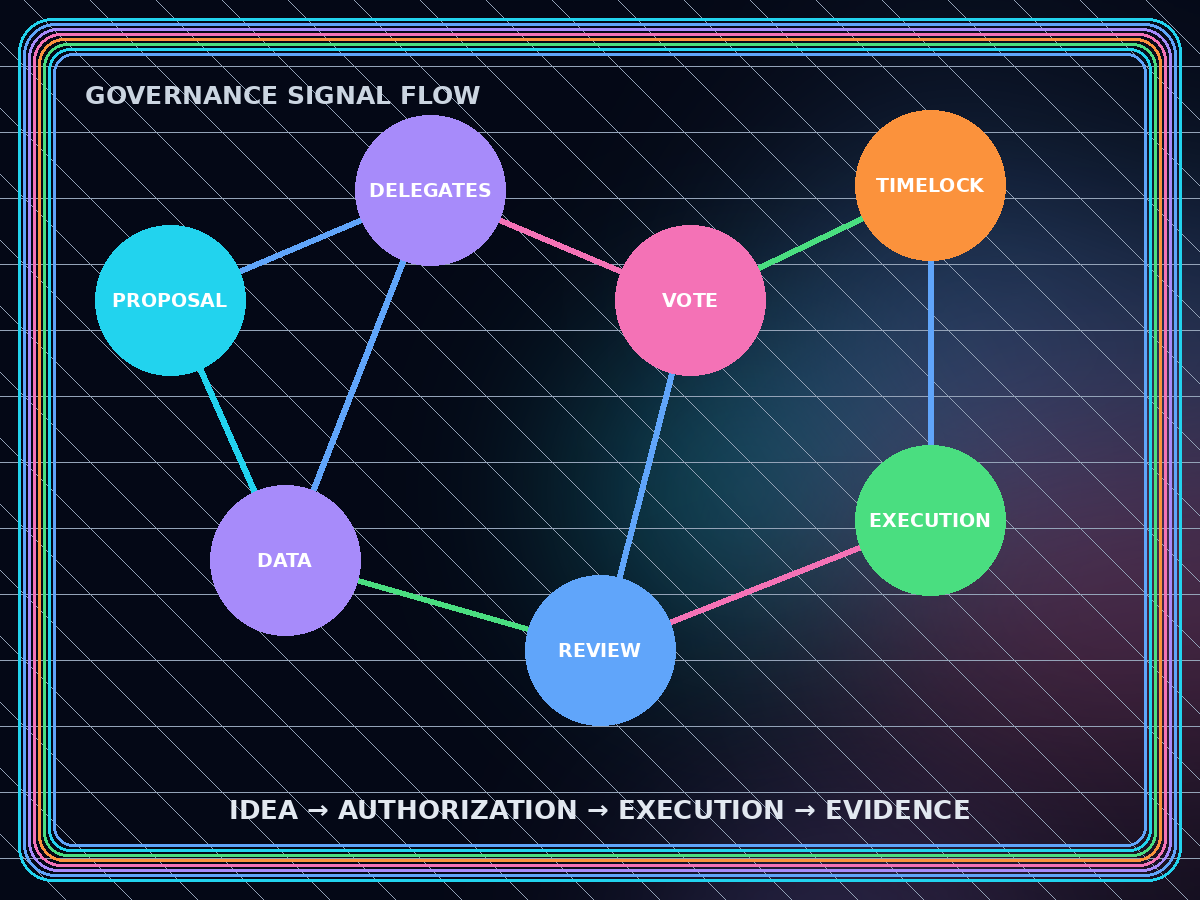
A public vote is only one layer. Reliable governance connects deliberation, authorization, technical execution, and post-decision review.
Define the problem, affected stakeholders, alternatives, evidence, and decision owner.
Connect the public description to thresholds, choices, call data, budgets, and dependencies.
Apply the protocol’s voting-power snapshot, quorum, approval, and timing rules.
Use timelocks, simulations, multisigs, or contract execution to implement the approved action.
Confirm the state change, measure results, and feed evidence into the next decision.
Map protocol authority, roles, proposal lifecycles, timelocks, and execution.
Compare on-chain, off-chain, delegated, approval, weighted, and quadratic methods.
Evaluate delegate discovery, rationales, revocability, compensation, and concentration.
Measure turnout, power concentration, proposal quality, delegation, and execution.
Governance can combine several mechanisms. The important question is what assurance the decision requires and who remains accountable for implementation.
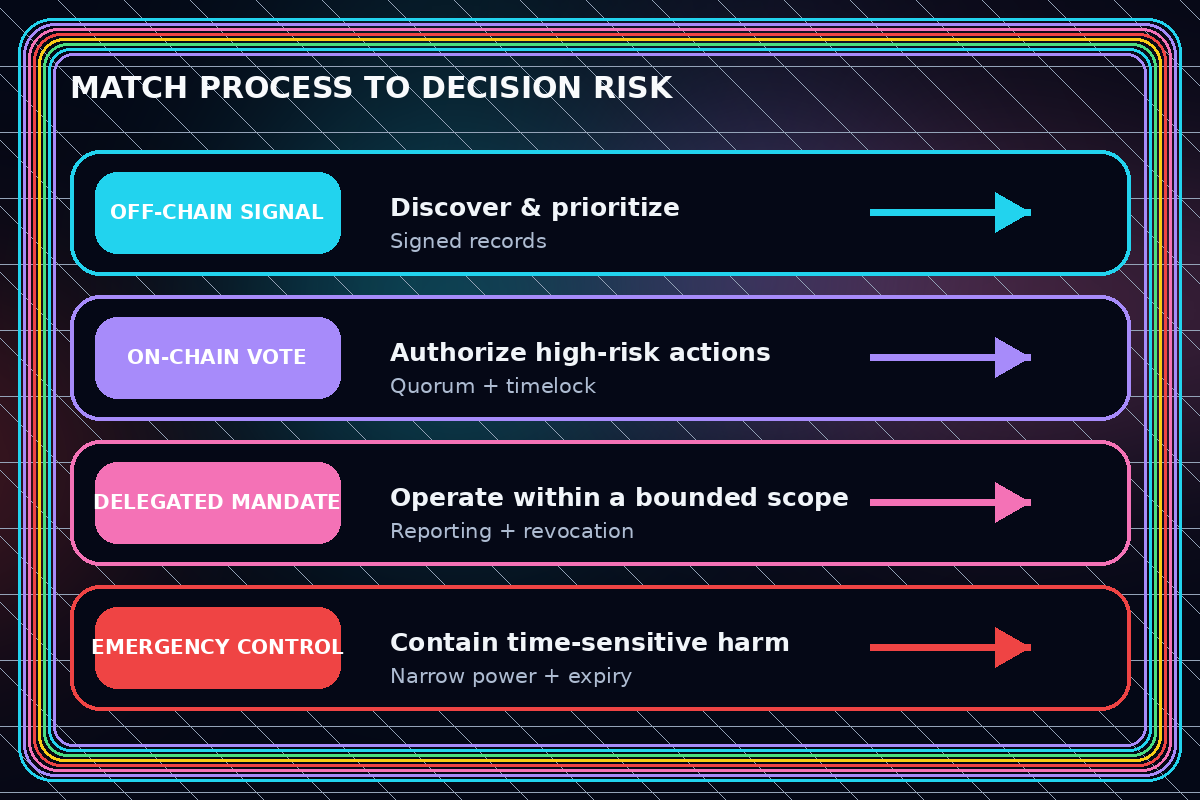
| Governance layer | Best used for | Key control |
|---|---|---|
| Off-chain signal | Discovery, prioritization, sentiment, elections | Reproducible signed records and clear binding status |
| On-chain vote | Protocol changes, large transfers, role changes | Historical voting power, quorum, decoded actions, timelock |
| Delegated mandate | Routine grants, operations, specialized review | Bounded scope, reporting, revocation, conflict disclosure |
| Emergency control | Pauses and time-sensitive containment | Narrow permissions, public alerts, expiry, removal path |
Design a reliable governance data layer for organizations, proposals, votes, delegates, executions, notifications, and analytics.
Understand how validators, delegators, staking weight, proposal deposits, vote inheritance, and upgrades interact in network governance.

Build a governance dashboard that measures participation, concentration, proposal quality, execution, and representative accountability.
DeFi governance is the process and technical authority used to change protocol parameters, contracts, treasuries, roles, and decision rules.
On-chain voting records and verifies ballots through blockchain contracts and can connect directly to execution. Off-chain voting uses signed messages or other records outside the chain, usually lowering cost but requiring a separate execution path.
Standard vote delegation transfers governance power, not token custody. The exact effect and timing depend on the protocol’s token and governor contracts.
Quorum is the minimum participation level required for a proposal to be valid. Its denominator and treatment of abstentions vary by governance framework.
No. DeFiVote.com is an educational static publication. It does not connect wallets, collect votes, submit proposals, or hold assets.
Send the page URL, the specific issue, and a primary source when available.