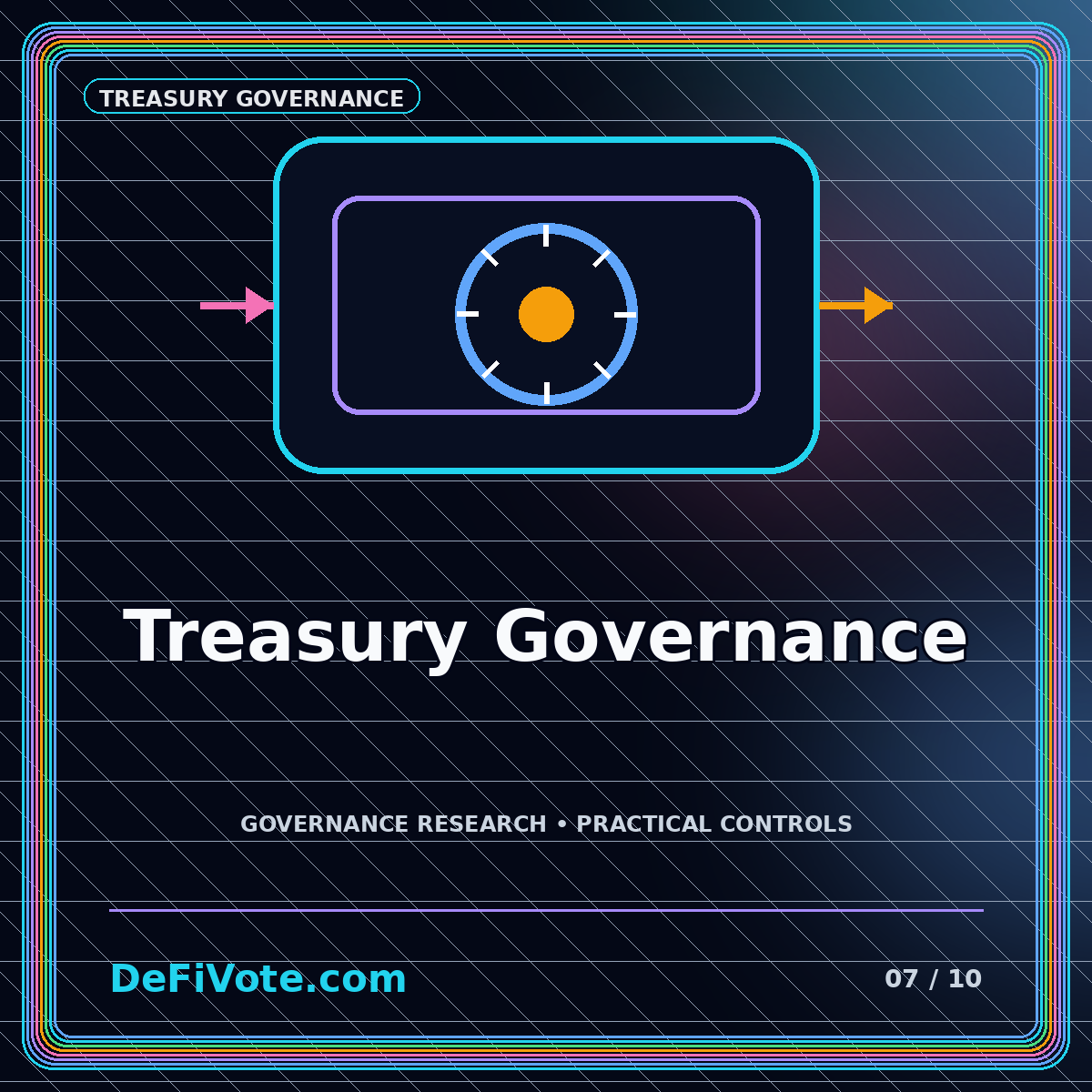
A DAO treasury is governed well when participants can understand why money is being spent, who authorized the payment, how the transaction will be executed, and whether the funded work produced the promised result. A token vote alone does not answer those questions. Treasury governance combines policy, budgeting, proposal quality, transaction security, milestone control, accounting, and public reporting. The process should be rigorous enough to protect shared assets without forcing the entire community to vote on every routine invoice.
Separate treasury policy from individual payments
Treasury policy establishes the boundaries within which spending decisions occur. It can define strategic priorities, reserve targets, diversification constraints, stable-asset needs, risk limits, approval thresholds, and the authority delegated to committees or working groups. Individual payments then apply that policy to a grant, service agreement, contributor budget, investment, or operational expense.
This separation reduces repetitive governance. Token holders can approve an annual ecosystem budget and mandate, while a grants council evaluates applications within that envelope. Larger or unusual commitments return to a full vote. The policy should state which decisions are delegated, what evidence the delegate body must publish, and when unused authority expires.
Build a legible budget architecture
A treasury budget is easier to govern when funds are grouped by purpose rather than listed as an undifferentiated balance. Common categories include protocol development, security, growth, grants, governance operations, legal or compliance work, contributor compensation, and reserves. Each category can have an owner, period, target, and reporting cadence.
Budgets should distinguish commitments from cash already transferred. A twelve-month grant agreement may create a full commitment even when payments are released quarterly. Dashboards that show only wallet balances can understate obligations. Governance participants need a view of available funds, restricted funds, approved but unpaid amounts, and expected recurring costs.
What a strong funding proposal contains
A treasury proposal should identify the recipient, objective, requested amount, denomination, payment schedule, scope, measurable outputs, key assumptions, conflicts, and responsible reviewer. For services, it should explain whether the price is fixed, time-based, or milestone-based. For grants, it should describe what evidence will demonstrate progress. For investments or liquidity programs, it should disclose downside scenarios and exit conditions.
The request should also make comparison possible. What alternatives were considered? Is the recipient uniquely qualified? What happens if the community approves less than the requested amount? A clear proposal does not guarantee a good decision, but it reduces the chance that voters authorize a vague headline and discover the operational terms later.
Match approval to risk
Not every transfer needs the same process. A risk-tiered policy can consider amount, reversibility, recipient history, asset volatility, contract interaction, and strategic significance. Small recurring payments within an approved budget may require committee approval and public notice. Large transfers, new counterparties, token swaps, or smart-contract deposits may require a token vote, independent review, and a timelock.
Thresholds should not be based only on nominal value. A transaction that grants an allowance or role may create more exposure than its immediate transfer amount suggests. The review should evaluate the maximum authority created by the transaction, including recurring streams, unlimited approvals, and upgrade permissions.
From authorization to multisig execution
Many DAOs use a smart-account multisignature wallet to hold treasury assets or execute transactions approved elsewhere. A multisig can require several owners to confirm the same transaction before it is submitted on-chain. The Safe Transaction Service documentation describes infrastructure for tracking Safe transactions, collecting signatures off-chain, and informing owners about pending transactions. That coordination layer is operationally useful, but governance still needs a clear rule connecting an approved proposal to the exact transaction signers confirm.
Signers should verify the destination, token, amount, network, nonce, and call data against the authorization record. They should not be expected to reinterpret policy at the final step unless their mandate explicitly includes discretion. Conversely, “the vote passed” should not force signers to execute a transaction that does not match the proposal. A published transaction digest or decoded action list can bridge the two records.
Use milestones for uncertain work
Upfront funding may be appropriate for trusted recurring operations, but novel or high-uncertainty projects benefit from staged release. Milestones can tie payments to deliverables such as a specification, testnet deployment, audit, public report, adoption target, or maintenance period. The milestone reviewer should be named in advance and use criteria visible to the recipient and community.
Milestones should avoid turning every creative project into a rigid checklist. Outcomes can change as information improves. The agreement can allow revisions through a documented change process while preserving the DAO’s ability to stop funding when the original value proposition no longer holds.
Streams, vesting, and clawback design
Payment streams release funds over time, improving predictability and reducing the amount exposed at once. Vesting can align long-term contributor incentives, while a cancellation right can protect the treasury if work stops. These controls should be used carefully. A unilateral cancellation controlled by one person may create employment-like dependence or political pressure. A clawback that is technically impossible offers only symbolic protection.
The proposal should identify who can pause or cancel, under what conditions, and how disputes are resolved. It should also explain tax, custody, or legal assumptions without pretending the DAO vote replaces professional advice. Treasury mechanisms are technical tools; the surrounding agreement determines how they should be used.
Reporting closes the governance loop
Recipients should report against the same objective and milestones presented in the proposal. Useful updates cover funds received, funds spent, work completed, blockers, changes in scope, and the next period. Reports should link to verifiable artifacts such as repositories, research, dashboards, event records, or transaction hashes where appropriate.
The DAO should aggregate these reports into a treasury view that distinguishes program activity from token-price changes. A rising treasury value does not prove successful spending, and a falling value does not necessarily indicate poor grants. Governance needs both financial statements and program outcomes.
Operational security for treasury transactions
- Use separate accounts or modules for reserves, operating funds, and high-risk strategies.
- Maintain signer redundancy while avoiding a threshold so low that compromise becomes easy.
- Verify addresses through more than one channel and use address books with change controls.
- Simulate contract interactions and inspect token approvals before signing.
- Set alerts for large transfers, owner changes, module enablement, and threshold changes.
- Document signer replacement, recovery, and incident procedures.
Security policy should include routine operations. Signers who only meet during emergencies may discover expired hardware, lost access, or incompatible software at the worst moment. Scheduled test transactions and role reviews make the treasury more resilient.
A model workflow
- A budget owner publishes a request using a standard template.
- Reviewers confirm scope, conflicts, recipient, and available budget.
- The proposal follows the approval track appropriate to its risk tier.
- An executor creates the transaction and publishes decoded details.
- Multisig owners verify the transaction against the authorization record.
- Funds are released upfront, by stream, or by milestone as approved.
- The recipient reports progress and the budget owner records commitments and payments.
- The community reviews outcomes before renewal or expansion.
This workflow creates evidence at each handoff. It makes it easier to locate a delay, dispute, or control failure without relying on private messages.
Conclusion
DAO treasury governance is the discipline of turning shared priorities into controlled, observable spending. Strong systems separate policy from routine payments, match approval to risk, connect votes to exact transactions, and make recipients accountable for outcomes. Multisigs, streams, and timelocks are valuable tools, but they do not replace clear mandates and reporting. A treasury becomes genuinely community governed when authorization, execution, and results can all be traced in public.
Continue exploring DeFi governance
Build context with the governance guide, execution analytics, and governance security checklist.