Token governance turns ownership or delegated voting power into authority over a protocol. The visible moment is the vote, but the security and legitimacy of the outcome depend on every stage around it: how voting power is created, who may propose, when balances are measured, how quorum is calculated, what actions are queued, and whether execution matches the approved payload. Understanding the full lifecycle makes governance easier to evaluate and much harder to manipulate through procedural shortcuts.
Stage 1: voting power is defined
A governance token does not automatically create a complete voting system. The protocol must define which balances count and how they are measured. Some systems use transferable token balances. Others use delegated balances, staked positions, vote-escrowed tokens, or a wrapper that records historical checkpoints. The design should make it possible to determine a voter’s power at a specific time without relying on the voter’s current balance.
Historical checkpoints matter because tokens move. If voting power were calculated only at the moment a ballot is cast, the same tokens might be transferred among addresses and used repeatedly. A snapshot or checkpoint fixes the relevant state for a proposal. It also clarifies whether tokens acquired after the proposal begins can participate. Participants should know the applicable block or timestamp before they make decisions about delegation or custody.
Stage 2: holders delegate or self-delegate
Many token-governance frameworks separate token ownership from active voting power. A holder delegates votes to an address, which may be the holder’s own wallet or a representative. The tokens do not move; the governance contract records which address can exercise the associated votes. This structure supports representative participation and lets a single delegate aggregate power from many holders.
Delegation introduces timing and communication requirements. If a protocol measures voting power at a proposal’s snapshot, a delegation made after that point may not count for the current vote. Interfaces should explain this clearly. Communities should also provide delegate profiles, conflict disclosures, and voting rationales so that delegation is an informed choice rather than a popularity contest.
Stage 3: an idea becomes an executable proposal
A governance proposal should specify both intent and action. The intent describes the problem, desired outcome, tradeoffs, and evidence. The action identifies what the governance contract will call if the proposal succeeds: target addresses, function signatures, encoded parameters, and any assets transferred. A proposal can contain multiple actions, which means one ballot may authorize a coordinated package of changes.
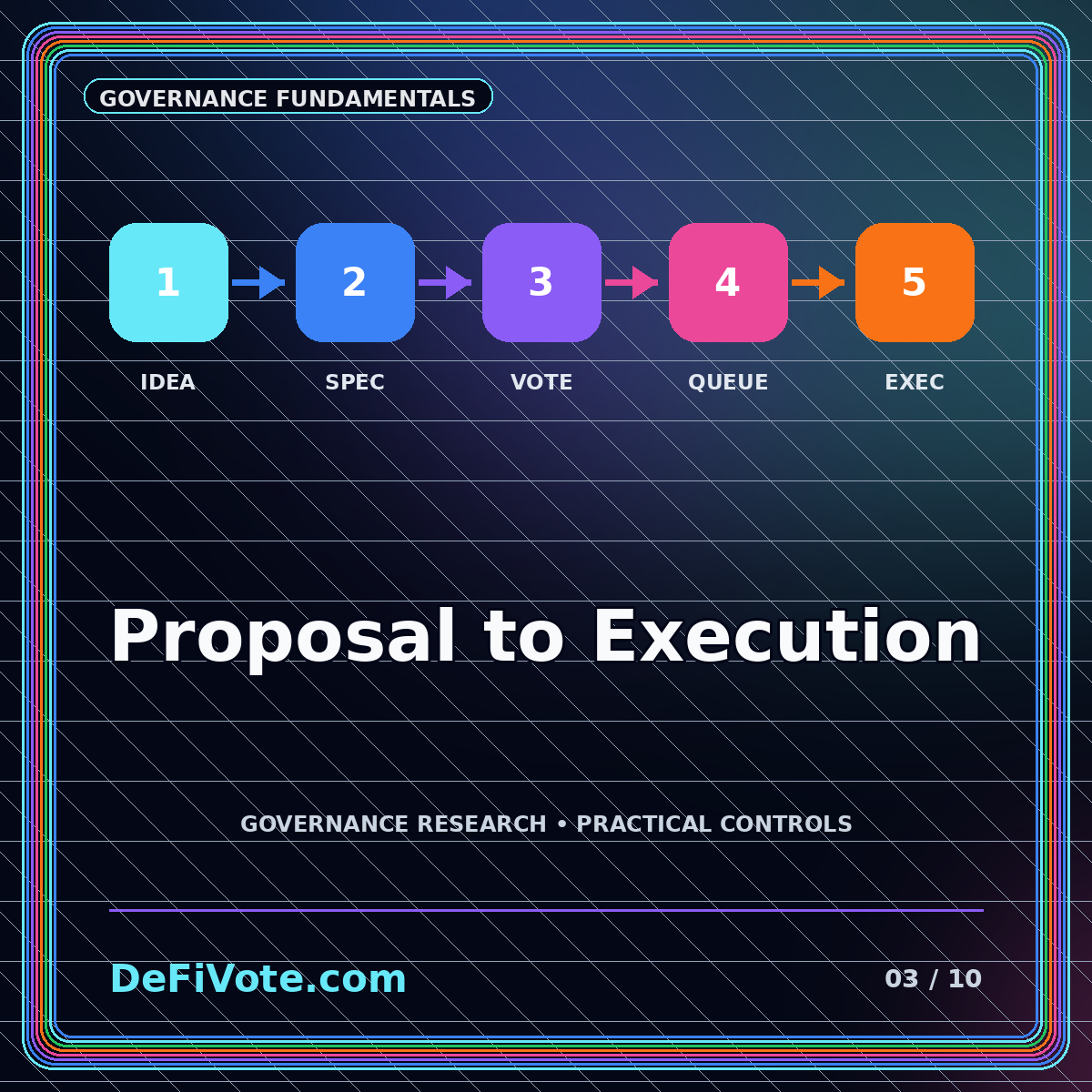
The OpenZeppelin guide to Governor contracts shows a modular on-chain lifecycle in which proposals are created, voted on, queued, and executed. Modularity is useful because protocols can choose different quorum, counting, token, and timelock components. It also means reviewers must understand the exact combination deployed by the protocol rather than assume every Governor behaves identically.
Stage 4: the proposal threshold is checked
A proposal threshold requires the proposer to control or receive delegation of a minimum amount of voting power. The threshold discourages spam and signals that an idea has some preliminary backing. If it is too low, voters may face an endless queue of poorly developed proposals. If it is too high, large delegates gain agenda control even when smaller participants could form a majority around an issue.
Alternatives include proposal sponsorship, refundable deposits, staged temperature checks, or a council that advances proposals meeting published criteria. Each method changes who bears the cost of filtering. A transparent process should explain not only the numeric threshold but also how participants without sufficient power can find sponsors or combine support.
Stage 5: voting delay and voting period begin
A voting delay creates time between proposal submission and the start of voting. This window allows participants to read the proposal, inspect the payload, adjust delegation for future eligibility where the rules permit, and identify obvious mistakes. A zero-delay system can favor actors who monitor the chain continuously and disadvantage participants in other time zones.
The voting period defines how long ballots are accepted. Short periods reduce the time during which protocol changes are pending, but they can suppress participation and technical review. Long periods increase access but may produce fatigue or slow urgent changes. The appropriate duration depends on the protocol’s risk, participant base, and whether proposals were thoroughly discussed before submission.
Stage 6: votes are counted
The simplest counting rule records votes for, against, or abstain. Even here, details matter. Does abstain contribute to quorum? Is approval based on a simple majority of for and against votes, a supermajority, or a fraction of total eligible power? Are late vote changes permitted? Can a voter split power among options? The contract’s counting logic, not the interface labels, determines the result.
Quorum protects against a tiny active minority making decisions for an inactive majority. A fixed quorum is easy to understand but may become inappropriate as token supply and delegation patterns change. Dynamic or historical quorum can adapt to observed participation, yet it is more complex and can be gamed if the formula is poorly designed. Communities should monitor both nominal quorum and the concentration of the votes that satisfy it.
Stage 7: the proposal reaches a final vote state
After the voting period, the governor evaluates the result. A proposal may be defeated because it lacks approval, because it misses quorum, or because another rule fails. Distinguishing these outcomes is useful. A proposal that wins a large majority but misses quorum presents a participation problem. A proposal with high turnout and a narrow loss presents a preference conflict. Governance analytics should not reduce both to the same “failed” label.
Successful proposals should retain an immutable connection between the voted-on description and the executable actions. If a material correction is needed, the safer approach is usually to cancel and resubmit rather than silently change what will execute. Proposal identifiers, action hashes, and public simulations help participants verify that the final package is the one they reviewed.
Stage 8: timelock and queue
A timelock inserts a delay between approval and execution. The proposal is queued with an earliest execution time. During that period, token holders, integrators, and security teams can inspect the result, prepare for the change, or respond if the payload is malicious or materially mistaken. A timelock is not a substitute for review; it is a final safety window after the community has authorized an action.
The length of the delay should reflect the available response mechanisms. A long timelock is less useful if users cannot exit, pause integrations, or organize a cancellation. A short timelock may be adequate for low-risk parameter changes but insufficient for an upgrade that controls substantial assets. Protocols may use different tracks for routine and exceptional decisions, provided the classification cannot be abused to bypass scrutiny.
Stage 9: execution
When the timelock expires, an authorized caller—or sometimes any caller—can execute the queued actions. Execution can fail because a target contract changed, a balance is insufficient, a permission was revoked, or one action in a batch reverts. Proposal simulation before voting and again before execution can identify many of these issues. The proposal should also state whether actions are atomic: if one fails, do all revert, or can partial execution occur?
Interfaces should display transaction receipts and resulting state changes, not merely mark a proposal “executed.” For example, a treasury transfer should be confirmed at the destination, and a parameter update should be read from the contract. This closes the gap between governance state and protocol state.
Stage 10: post-execution review
Governance continues after the transaction. The community should compare actual effects with the proposal’s expected outcome. A risk-parameter change may alter utilization or liquidations. A grant may have milestone and reporting obligations. An upgrade may require monitoring for regressions. Establishing review dates in the proposal creates accountability and gives later voters better evidence.
Post-execution review also improves process design. Repeated failures may reveal that the voting period is too short, payloads are poorly decoded, or proposal owners lack operational capacity. The best governance systems learn from their record rather than treating every proposal as an isolated event.
A practical review checklist
- Confirm the voting token, delegation model, and snapshot rule.
- Check the proposer’s threshold and any sponsor relationships.
- Compare the human-readable description with every executable action.
- Verify voting delay, period, quorum, approval, and abstention treatment.
- Review simulations, audits, dependencies, and rollback options.
- Identify the timelock, cancellation powers, and execution deadline.
- Require evidence that the approved state change actually occurred.
Conclusion
Token governance is a chain of controls. Delegation determines who can act; thresholds determine who can set the agenda; snapshots determine which power counts; quorum and counting rules determine approval; timelocks create a response window; and execution converts the vote into protocol state. A weakness at any stage can outweigh the apparent openness of the ballot. Evaluating the full lifecycle gives voters and builders a clearer view of where authority truly sits and how safely it can be exercised.
Continue exploring DeFi governance
Build context with the DeFi governance guide, governance API design, and governance security threat model.