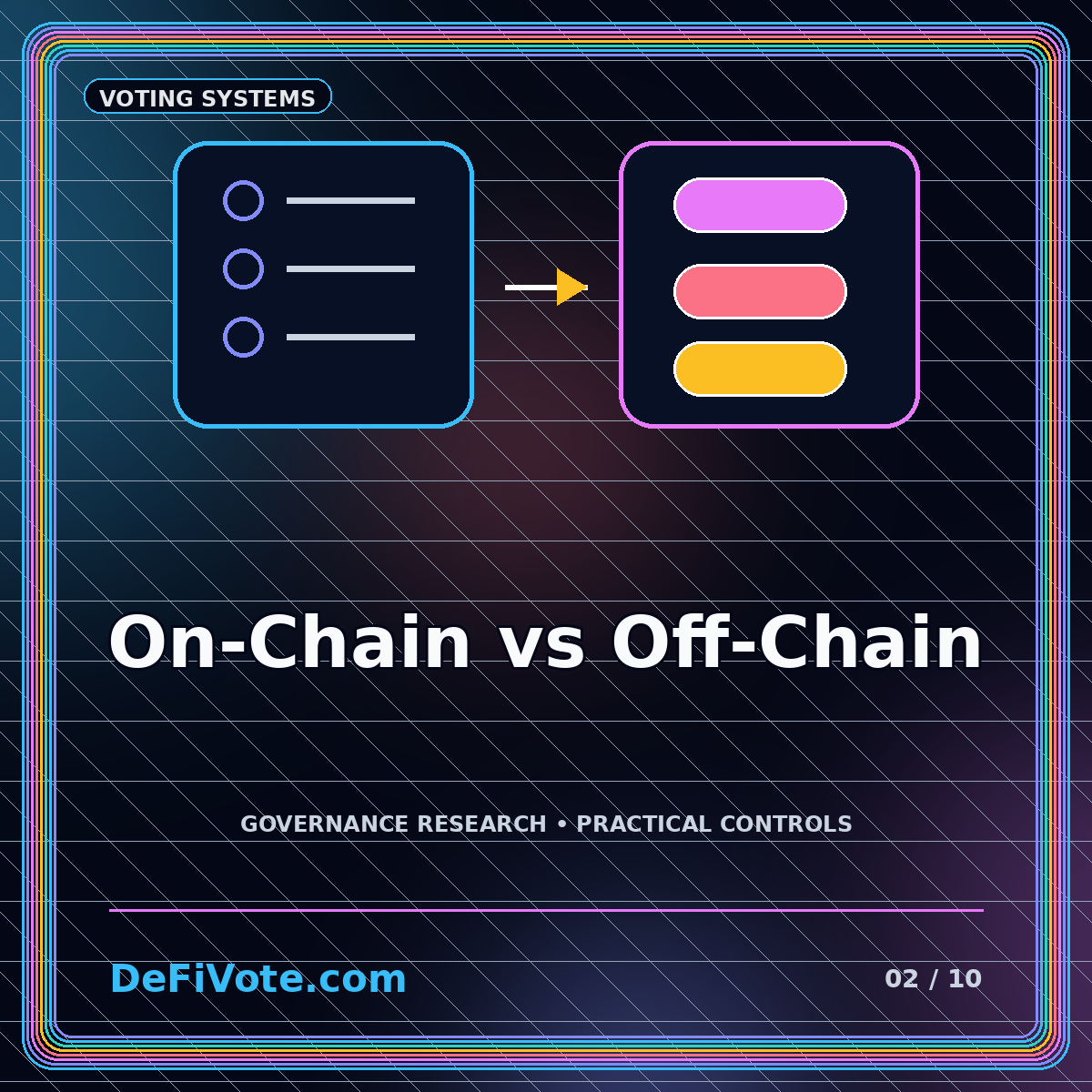
Choosing where a vote is recorded is one of the most consequential design decisions in DAO governance. On-chain voting writes ballots and results to a blockchain and can connect approval directly to smart-contract execution. Off-chain voting usually relies on wallet-signed messages stored and counted outside the chain, reducing transaction costs and allowing faster experimentation. Neither model is universally superior. The right choice depends on the value at risk, the need for automatic execution, participation barriers, and the amount of trust the community is prepared to place in operators.
What on-chain voting means
In an on-chain system, a vote is a blockchain transaction or an action verified by an on-chain voting contract. The contract determines eligibility, reads voting power at a defined snapshot or checkpoint, counts ballots, and moves the proposal through states such as pending, active, succeeded, queued, and executed. Because the result is available to other contracts, a successful proposal can trigger a timelock and then execute without a separate party deciding whether to honor the outcome.
This model creates a strong connection between authorization and action. Anyone can inspect the transaction history and recalculate the result from chain data. The tradeoff is that voters must interact with the chain. They may need native tokens for transaction fees, compatible wallets, and enough technical confidence to sign the correct transaction. Congested networks can make participation expensive precisely when a high-profile proposal attracts attention.
What off-chain voting means
Off-chain voting moves ballot submission outside the blockchain. A participant signs a structured message with a wallet, and an application records the signature with the proposal data. Voting power can still depend on an on-chain state snapshot, such as a token balance or delegated balance at a particular block. The key difference is that the ballot itself is not an ordinary state-changing transaction, so the voter usually pays no gas.
Snapshot’s documentation describes a flexible off-chain voting platform for DAOs and DeFi communities, including customizable voting strategies and multiple voting systems. This flexibility is valuable for temperature checks, prioritization polls, elections, grants, and other decisions that benefit from broad participation. However, an off-chain result does not inherently change a smart contract. Someone or something must translate the outcome into an executable action.
The central tradeoff: execution assurance
The strongest case for on-chain voting is credible execution. If the proposal passes and satisfies the contract’s rules, the same governance system can queue and execute the specified actions. Participants do not have to rely on a core team to interpret the vote or decide whether to proceed. This is especially important when a proposal changes protocol parameters, upgrades code, transfers a large treasury amount, or alters control over critical roles.
Off-chain voting separates preference measurement from execution. That separation can be intentional. A community may want to test sentiment before spending engineering time on a final payload. It may also want a human review step to catch errors. But the separation introduces discretion: a multisig, foundation, or operational team may need to implement the result. The governance process should state whether the vote is binding, who is responsible for execution, and what happens if the implementation differs from the approved text.
Cost and participation
Transaction fees create unequal friction. A large delegate may consider a modest fee trivial, while a small holder may reasonably skip a vote whose personal influence is limited. Fee volatility can also make participation unpredictable. Off-chain signatures lower that barrier and often produce a smoother mobile experience. They are therefore useful when the goal is to collect a wide signal rather than authorize immediate control over assets.
Cost is not the only participation variable. Voters need understandable proposals, enough time, reliable notifications, and confidence that their ballot will count. An off-chain system with poor communication can have lower turnout than a well-run on-chain system. Conversely, subsidized or relayed on-chain transactions may reduce the fee barrier. Designers should measure where participants drop out instead of assuming the recording layer alone determines engagement.
Auditability and data availability
On-chain ballots are embedded in the ledger’s transaction history. Indexers can fail, interfaces can disappear, and APIs can change, but the underlying records remain available from the network. This supports independent verification and long-term analysis. The cost is storage and execution overhead, which encourages compact vote formats and may limit more expressive mechanisms.
Off-chain systems can also be auditable when they publish signed messages and proposal metadata to durable public storage. Observers can verify that a signature corresponds to a wallet and that voting power was calculated using the stated rules. The weak point is often not signature validity but system completeness: whether all valid ballots are available, whether the correct snapshot was used, and whether the final count matches the published data. A good off-chain process makes those inputs reproducible.
Flexibility and voting design
Off-chain tools make it easier to experiment with ranked choice, weighted choice, approval voting, quadratic methods, or custom eligibility rules without deploying new execution contracts. This is useful when a community is learning which mechanism fits a particular type of decision. It also allows non-binding polls that would be unnecessarily expensive or risky to encode as executable proposals.
On-chain systems can support sophisticated voting too, but complexity increases audit burden and gas use. A modular governor may combine different counting, quorum, and timelock components, yet every module becomes part of the security boundary. For high-value decisions, simplicity can be a feature. A clear “for, against, abstain” rule with well-tested execution may be safer than an expressive mechanism that few participants understand.
Hybrid governance patterns
Temperature check followed by binding vote
A common pattern begins with an off-chain poll to determine whether an idea deserves more work. If support is sufficient, contributors prepare code, audits, and an executable proposal for an on-chain vote. This reduces the cost of rejecting weak ideas while preserving trust-minimized authorization for the final action.
Off-chain vote with guarded execution
Some systems use an off-chain result to authorize a multisig or module, subject to a challenge period. The execution path may include proof that the vote passed, a delay, and a mechanism to block an invalid transaction. This can reduce per-voter costs while improving assurance compared with a purely discretionary multisig.
Separate tracks by risk
A DAO can reserve on-chain voting for contract upgrades, treasury transfers above a threshold, and changes to governance itself. Routine grants, prioritization, and working-group decisions may use off-chain polls or delegated budgets. This risk-tiered approach avoids treating every decision as equally consequential.
A decision matrix for choosing the model
| Decision characteristic | Likely fit | Reason |
|---|---|---|
| Directly changes protocol code or permissions | On-chain | Strong execution assurance and public verification |
| Early sentiment or option discovery | Off-chain | Low cost and rapid iteration |
| Large treasury transfer | On-chain or guarded hybrid | Clear authorization and delayed execution |
| Community election with many candidates | Off-chain or specialized on-chain | More expressive ballots may be needed |
| Routine operational budget within a mandate | Delegated/off-chain | Reduces governance overhead |
The matrix is a starting point, not a substitute for threat modeling. A low-value decision can still affect legitimacy, and a technically binding vote can still be unsafe if the payload is unclear. The process should make the decision class, execution method, and escalation path visible before voting begins.
Operational controls that matter in both models
- Define the voting-power snapshot and make eligibility easy to verify.
- Publish a plain-language summary alongside machine-readable actions.
- Use a voting period that covers relevant time zones and review cycles.
- Document quorum, approval, tie, cancellation, and abstention rules.
- Assign an execution owner and deadline when the result is not self-executing.
- Archive proposal text, ballots, results, and post-execution evidence.
These controls determine whether the governance record can be trusted later. They also reduce disputes about what voters authorized. A sophisticated voting tool cannot compensate for changing proposal text, missing payload details, or an undefined implementation responsibility.
Conclusion
On-chain voting maximizes the connection between a public decision and executable authority. Off-chain voting reduces cost and supports flexible, high-participation deliberation. Hybrid governance uses each where it is strongest. The practical question is therefore not “Which system is more decentralized?” but “What assurance does this decision require, and what participation burden is justified by the risk?” A DAO that answers that question explicitly can build a process that is both usable and credible.
Continue exploring DeFi governance
Build context with the voting systems guide, DeFi governance map, and quadratic voting guide.