DeFi governance is the system a decentralized finance protocol uses to decide what may change, who may authorize the change, and how an approved decision becomes an operational result. It is often summarized as “token holders vote,” but that phrase hides most of the work. A functioning governance system also needs proposal standards, discussion venues, voting-power rules, execution controls, emergency procedures, and a way to evaluate whether past decisions produced the intended outcome.
Governance is the change-management layer of a protocol
A DeFi application can automate swaps, loans, collateral checks, liquidations, fee collection, and other financial actions through smart contracts. Automation does not eliminate judgment. Someone still has to decide which assets are supported, how conservative a risk parameter should be, when a contract should be upgraded, and what to do with protocol-owned funds. Governance is the mechanism that converts those judgments into legitimate, observable changes.
It helps to separate the protocol’s operating logic from its change authority. Operating logic handles routine transactions according to code. Change authority determines whether the code, parameters, permissions, or treasury instructions may be altered. A protocol can be highly automated in daily operation while remaining weakly governed if a small, opaque group controls upgrades. It can also be broadly governed yet operationally fragile if approved proposals are difficult to execute safely.
What DeFi communities actually govern
The governance surface differs by protocol, but most decisions fall into several recurring groups. Parameter decisions adjust values such as collateral factors, debt ceilings, fee rates, reward schedules, oracle settings, or market limits. Upgrade decisions replace or extend contract logic. Treasury decisions fund contributors, audits, grants, liquidity programs, legal work, or public goods. Role decisions appoint or remove guardians, multisig signers, committee members, or service providers.
Communities also govern process. They may change proposal thresholds, quorum rules, voting periods, delegation requirements, or the steps that must occur before an on-chain vote. These procedural choices deserve the same scrutiny as financial parameters because they shape who can participate and how easily power can be exercised. A low proposal threshold may invite experimentation but create noise. A high threshold may reduce spam while making the agenda dependent on a few large delegates.
Who participates in DeFi governance
Token holders are only one part of the system. Proposers turn an idea into a decision package. Delegates study issues and vote with power assigned by other holders. Risk contributors model market exposure. Engineers review code and executable payloads. Forum participants challenge assumptions and surface operational concerns. Guardians or security councils may pause specific functions or cancel a clearly malicious action under narrowly defined conditions.
These roles overlap, but they should not be treated as interchangeable. A technically correct proposal can still lack community legitimacy. A popular proposal can still contain unsafe call data. A delegate may be informed about treasury policy but unqualified to validate a contract upgrade. Good systems make responsibilities explicit, publish supporting material, and provide enough time for specialists and general participants to review the parts they understand.
From shared mission to executable rules
A DAO is commonly described as a collectively owned organization coordinated around a shared purpose. The Ethereum.org overview of DAOs emphasizes that blockchain-based rules can define how an organization works and how funds are spent. In practice, those rules are only one layer. Durable governance also depends on social norms, proposal-writing quality, accessible communication, and reliable execution infrastructure.
This combination of social and technical layers is important. Forums and calls are useful for discovering preferences, but they do not automatically move assets or update contracts. Smart contracts can enforce a vote result, but they cannot guarantee that the proposal text clearly disclosed the consequences. Governance quality comes from connecting deliberation, authorization, and execution without pretending that any one layer is sufficient.
The typical proposal lifecycle
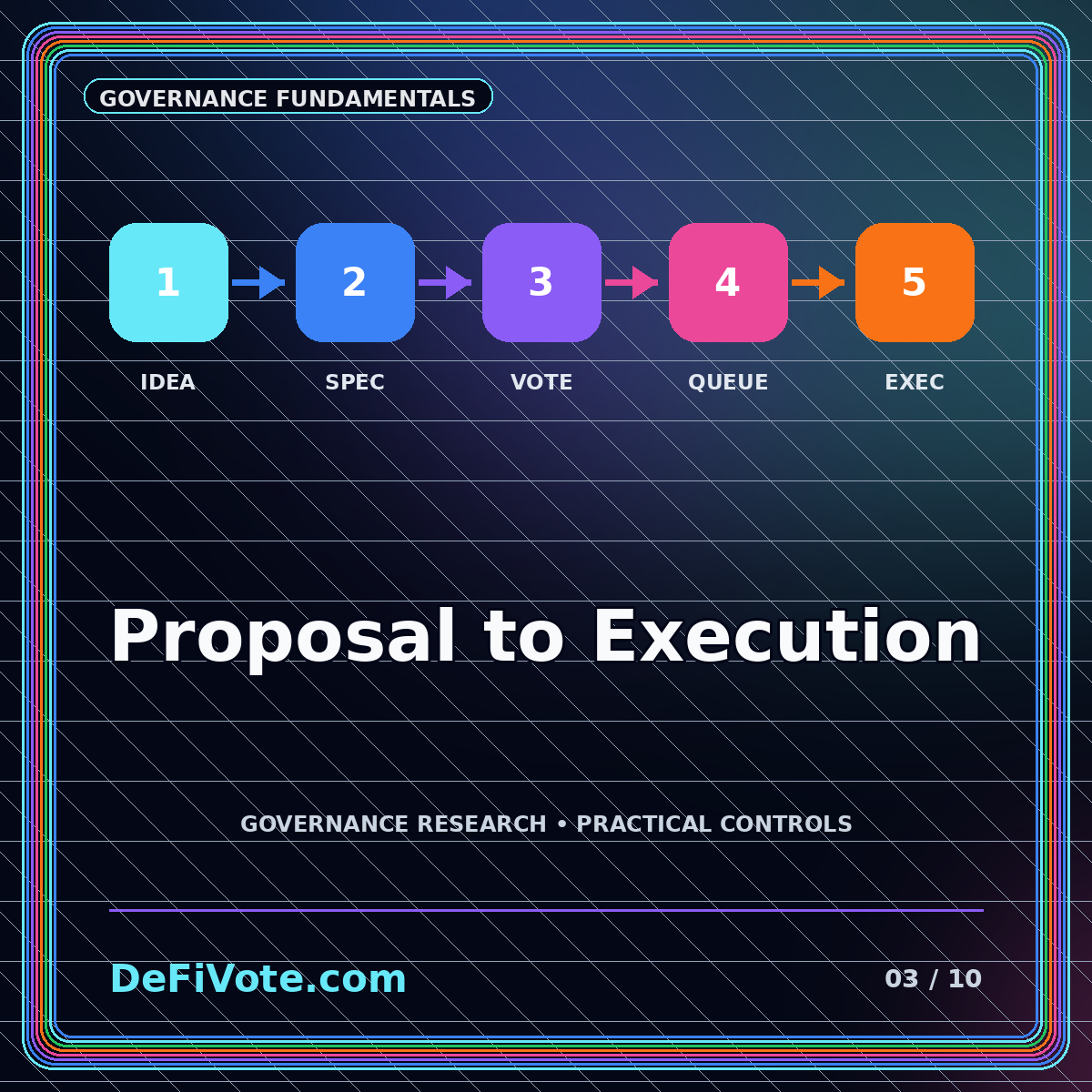
1. Idea and discussion
An idea usually begins as a forum post, working-group draft, research note, or request for comment. The goal is to identify the problem, affected stakeholders, available options, and evidence. Strong early discussion separates the desired outcome from the proposed implementation. That makes it possible to improve the mechanism without losing sight of the objective.
2. Proposal specification
The proposer translates the preferred option into a precise package. A non-executable proposal may ask the community to signal direction. An executable proposal includes contract targets, function calls, values, and other data that will run if the vote succeeds. The specification should explain assumptions, dependencies, budget implications, rollback options, and who is responsible for follow-through.
3. Voting and authorization
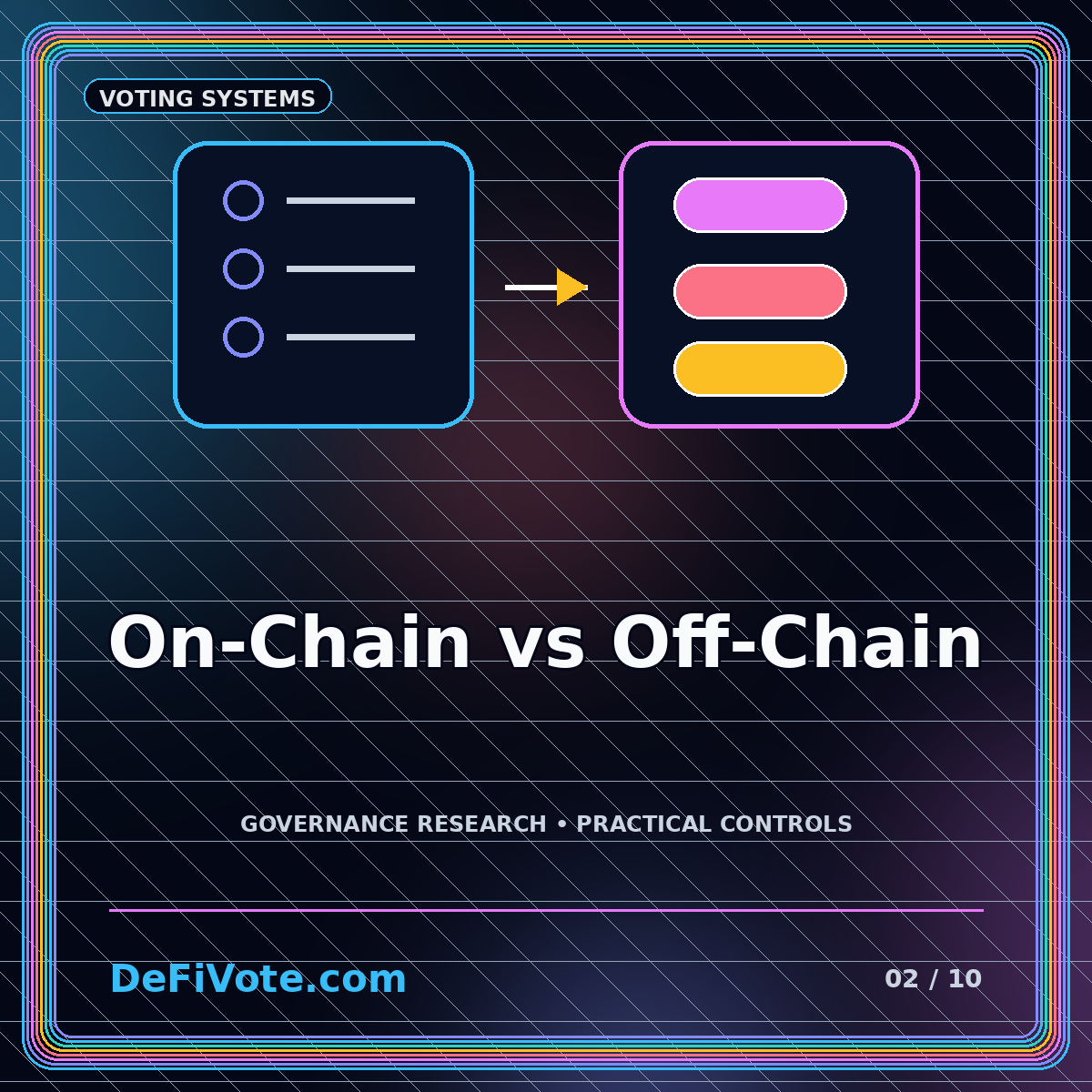
Eligible voters cast ballots according to the protocol’s rules. Voting power may come from token balances, delegated balances, staked positions, reputation, membership credentials, or a combination. The proposal must satisfy the configured approval test, which may include quorum, a majority or supermajority, and separate rules for abstentions or vetoes.
4. Queue, execution, and review
Many systems place successful proposals in a timelock before execution. This delay gives participants time to verify the final payload and respond to an unexpected outcome. After execution, the community should confirm that the intended state change occurred and measure results. A proposal is not complete merely because the vote closed; completion requires verified implementation and documented follow-up.
Core design questions
Every governance system should answer a small set of difficult questions. Who can submit a proposal, and what prevents spam without blocking legitimate minorities? When is voting power measured, and can it be borrowed or moved during a vote? What level of participation is required for a decision to be representative? Which decisions can execute automatically, and which require an additional operational step?
The system also needs an explicit approach to emergencies. A pause mechanism can reduce damage during an incident, but broad pause authority creates its own centralization risk. A guardian can cancel a malicious proposal, but an undefined veto can undermine voter sovereignty. The design goal is not to remove all trusted roles at once. It is to limit their scope, make their actions visible, and create a credible path for reducing or replacing them as the protocol matures.
Common governance failure modes
- Low participation: important decisions are made by a small fraction of eligible voting power.
- Power concentration: a few holders or delegates can determine outcomes with little coalition building.
- Ambiguous proposals: voters approve a headline while the executable details imply something different.
- Operational gaps: a successful vote depends on a team or multisig that has no clear deadline or accountability.
- Governance fatigue: too many low-value votes reduce attention for decisions that carry real risk.
- Capture by procedure: agenda control, timing, or proposal thresholds matter more than the nominal voting rule.
These problems are not solved by maximizing the number of voters or putting every choice on-chain. The aim is informed, legitimate, and safely executable decision-making. Some routine actions are better delegated to bounded committees. Some high-impact actions deserve long review periods and direct token-holder approval. The governance architecture should match the reversibility and risk of the decision.
How to evaluate a DeFi governance system
Start by mapping authority. Identify the contracts, multisigs, guardians, upgrade keys, and treasury accounts that can change protocol state. Then trace a proposal from its first public discussion through execution. Look for hidden handoffs, unclear signers, or points where the public vote is merely advisory. Review how voting power is distributed and delegated, not just the circulating token supply.
Next, inspect the quality of information available to voters. Are executable actions decoded in plain language? Are risks, costs, and conflicts disclosed? Can participants compare the proposal with alternatives? Finally, examine outcomes: execution success, time to implement, post-decision reporting, and whether emergency powers were used. A governance system should be judged by how it handles real decisions, not only by how decentralized its diagram appears.
Conclusion
DeFi governance is a complete decision system, not a voting widget. It connects community intent, technical authority, risk controls, and operational accountability. The most resilient designs make power legible, match process to decision risk, and treat execution and review as part of governance rather than as afterthoughts. Understanding those layers makes it easier to compare protocols, participate as a voter or delegate, and recognize when a “community-governed” claim is stronger in branding than in practice.
Continue exploring DeFi governance
Build context with the DeFi governance guide, DAO voting systems, and proposal-to-execution lifecycle.